Literacy in New Visions Science
Alignment with English Language Arts is an innovation of the NGSS that is essential for making science accessible for all students. Below, you’ll find information about both the embedded literacy strategies employed by our courses and additional ways to scaffold access to texts and writing.
Supporting Reading in Science
Reading strategies support the building of a student-centered classroom in science. To make meaning from a text, students need support before reading, while reading, and after reading. Navigating complex texts can be an integral part of science teaching and learning, particularly as a part of the 5E Instructional Model. To support reading, we offer a menu of strategies that teachers can choose from to introduce students to complex texts, guide them through reading, and assess their understanding. Reading strategies embedded in our instructional materials are described below. Additional support resources can be found at the bottom of the list.
This strategy helps students recognize organizational patterns in text, steps in a process, and the importance of sequential order. It can be used with a graphic organizer or a card sort. This strategy is especially effective with language learners, as it allows for all students to interact with and make sense of complex relationships and concepts even when some vocabulary may be new or unfamiliar. Students are able to collaboratively experiment with putting steps or phrases in different orders to identify the most coherent sequence. In the Biology course, sequence charts are used throughout with an intentional progression. Early in the year, students construct a sequence chart using teacher created cards based on a text. After engaging with another text in another unit, students interpret a complex sequence chart based on that text. Finally, toward the end of the course students are asked to create a sequence chart based on a text.
This is a cognitive strategy that supports student sense-making while reading a complex text. By prompting students to annotate their text in the margin of the text itself or using sticky notes, they are provided with a structure for actively engaging with the content of the text and a means to make their thinking visible to themselves and to the teacher. Once annotations are recorded, they can be used by students to discuss the text with partners or with the class and can be used in writing tasks for textual support in explanations and arguments. Connections can more easily be made between the text and the phenomenon students are trying to figure out.
The purpose of this strategy is to activate prior knowledge, engage students in analysis and interpretation early in a unit, and get students to start to think about the culminating writing task. The strategy also allows the teacher to assess students’ readiness to engage with the complex text they will be close reading as the unit progresses. One way this is often done is by pulling relevant quotes to post on large paper, and having students annotate the quotes together in advance of reading the full text.
Three-level guides are designed to enable learners to access, analyze, and interpret information from a complex text. They can be used for video text, photographs, diagrams, and many different types of written texts across content areas. A three-level guide provides a series of prompts that guide students in their approach to making sense of a complex text. The prompts are divided by level of rigor: Level 1 is ‘Reading the lines’, Level 2 is ‘Reading between the lines’, Level 3 is ‘Reading beyond the lines’. Level 1 prompts are accessible to a wide range of learners, and serve as a scaffold toward Level 2 prompts which ask students to make connections between pieces of information in the text. After responding to Level 2 prompts, students are more likely to be prepared to respond to Level 3 prompts, focused on making inferences based on the relationships they see in the text.
This document includes the strategies described above as well as many other reading strategies that can be incorporated into instruction to support literacy in your classroom.
Supporting Writing in Science
Student-centered science instruction should provide students the opportunity to revisit and revise their conceptual understanding through experimentation and written reflection. Although there are multiple types of discipline-specific writing (e.g., narrative, procedure, and argumentation) that may be useful in a science classroom, constructing scientific explanations provides an especially rich opportunity for students to interact with data sets, to discuss their ideas with peers, and to demonstrate their understanding of important scientific concepts and vocabulary. Writing strategies embedded in our instructional materials are described below.
The emphasis in the NGSS on constructing scientific explanations and arguing from evidence is not a new one for science education. The heuristic C-E-R has been used for quite some time now, and has helped science teachers support students in shifting their explanations about scientific phenomena from opinion-based to evidence-based. Tools and scaffolds have been developed to support formally writing scientific explanations using the C-E-R framework. At the beginning of the course, the C-E-R framework is used, and it is likely students will have seen a similar scaffold in their middle school science classes. As students develop the practice of constructing explanations over time, the scaffold can be removed.
Supporting Literacy through Discourse
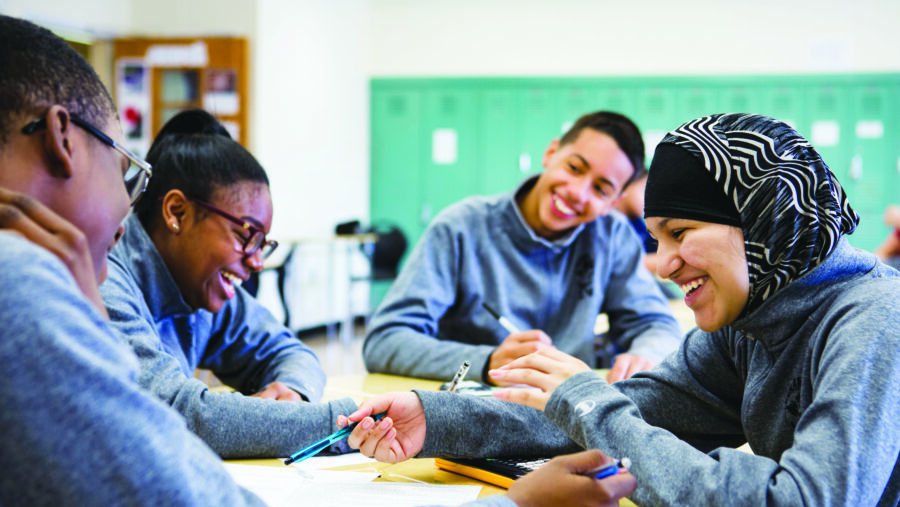
The group learning routines embedded in the teacher materials for this unit are designed to address a range of students’ background knowledge, language skills, and life experiences. Group learning routines enable students to collaborate with peers and deepen their understanding in ways that cannot be accomplished alone. When interviewed about group learning routines, students report that they are able to remember learning from lessons better because they can hear their friends’ voices describing the procedures to a problem or providing the evidence to support an argument. The routines foster the development of Common Core Standards for Speaking and Listening as well as the appropriate three dimensions from the NGSS. These group learning routines for discourse embedded in our instructional materials are described below. For more details on each routine, refer to the Course Guide
This routine, most frequently used during an Explain phase, is a way to ensure that the accurate scientific ideas students are figuring out are made public and visible for all students to access. It requires skillful teacher facilitation, as it is important to not tell students what they need to know, instead supporting students as a class in using the information they have from investigations, their models and texts in order to figure out and state those important ideas.
- Select a few different groups to share their work.
- The first group shares out their work. Sharing can be done by:
- a) projecting using a document camera
- b) copying the models to be shared and passing them out to the class
- c) taking a picture of each model and projecting them as slides
- Another person in class repeats or reiterates what the first group shared.
- Class members ask clarifying questions about the work.
- Repeat for each group that is sharing work.
- Everyone confers in table groups.
- Engage in whole-class discussion about the ideas that were shared, in order to come to agreement.
This routine, most frequently used during an Explain phase, is a way to make sensemaking visible and move towards a class-wide consensus around a new idea. This routine is similar to Domino Discover in terms of the action pattern, but the knowledge-building focus is different. Rather than surfacing a range of ideas and seeking patterns, in a Consensus-Building Share the class is attempting to converge on an agreed-upon explanation, model, or argument. It requires skillful teacher facilitation, as it is important to not tell students what they need to know, instead supporting students as a class in using the information they have from investigations, their models and texts in order to figure out and state those important ideas.
- Each small group or partnership prepares one or more reporters to share out ideas generated in the group.
- Decide which small group will share out first.
- Select and announce the small group that will go second, establishing the direction for the share.
- Reporters from each small group take turns sharing their thinking, adding on to or disagreeing with the previous group. This requires more think time than a Domino Discover, and that can be built into the action pattern by saying, “Since we are expecting everyone to add on or question other groups’ thinking as we go, you may find you need a moment to huddle with your group in between share-outs. Just ask for a moment to huddle, then resume the share!”
- ✫ Helpful sentence starters for groups to use are We agree with ’s group, and we have more evidence for that; or We came to a different explanation than ’s group because _.
- Reporters from each small group take turns sharing the collective thinking of their group until every reporter has gone.
- Record and annotate ideas from the class, clustering ideas that support the sense-making work of the class.
- Ask students to share patterns in thinking, surprises, or questions that arise.
- Invite anyone to add something that came up in their small group, but was not captured yet.
In this routine, students share out ideas rapidly, in a way that quickly surfaces ideas and informs instructional next steps. Since student ideas are shared quickly and effectively, this routine ensures that a range of thinking across the class is surfaced. This routine is often used after small group discussions, with one student reporting out their small group’s collective thinking. This should result in data the teacher needs to tailor instruction that will clarify, further, or review student learning.
- Each small group prepares one or more reporters to share out ideas generated in the group.
- Decide which small group will share out first.
- Select and announce the small group that will go second, establishing the direction for the Domino Discover.
- Reporters from each small group take turns sharing the collective thinking of their group until every reporter has gone, one after the other without interruption, like dominoes falling.
- Record ideas from all groups, or have a student act as recorder.
- Ask students to share patterns in thinking, surprises, or questions that arise.
- Invite anyone to add something that came up in their small group, but was not captured yet.
This routine supports groups of students in thinking through a set of related problems, tasks, or visuals, in order to develop a larger insight or discovery. Since students work in groups through multiple pieces of classmates’ work, they develop a layered understanding of a topic. This routine, therefore, is great for developing complex understandings of a phenomenon in science.
- Start each group at a poster in the room. Provide one marker per group, and ask groups to annotate the poster they are visiting, using the annotation guide below.
- Add a check mark where you agree with an idea
- Use a plus sign when you want to add an idea
- Star important ideas
- Circle the most important idea
- Rotate to the next chart and take your marker.
- Repeat steps (1) and (2) as many times as is necessary for each group to rotate to each other group’s poster.
- Make sure each group ends back and their own poster. Prompt them to notice changes and annotations on their chart.
This routine promotes student engagement in problem-solving. Often, when students get a problem to solve, whether this is a mathematical problem or a puzzling idea, they start jumping to answers. Many students need support to build a habit of generating many ideas before selecting the best one. This routine supports students in articulating their thinking and making it transparent, before considering solutions. Read-Generate-Sort-Solve works well if students follow the collaboration steps using chart paper, a whiteboard, or a virtual whiteboard — any space where they can work together on responding to the prompt, or solving the problem of the task. The R-G-S-S organizer can be created on chart paper, or printed as a poster.
- Assign students into groups of three with a range of student skill and background knowledge levels in each group.
- Designate where in the room each group of three will meet.
- For each round, each group has a speaker and two listeners. The teacher facilitating the routine acts as the time keeper. Assign one student in each group to speak first, then the students who will speak second and third.
- Students take turns sharing ideas they generated; this should be timed and proceed in rounds, to promote equity in sharing.
- Students collaborate in their groups to sort ideas and identify which ones are most relevant to the prompt.
- Students individually or as a group complete a final response.
The goal of this routine is to have students exchange ideas while listening for similarities and differences in thinking. Some strengths of this routine are that students get on their feet, everyone has to engage in conversation, and there is no wait time in between shares. It also gives the teacher an opportunity to listen to student ideas as they talk and to surface patterns in student ideas at the end of the routine. Rumors is meant to be low stakes, so it is frequently used in Unit 1 to surface initial student ideas about phenomena during the Engage phases.
- Invite students to join you in an open space with their completed sticky note from the Starting Position.
- Simultaneously, all students pair up, then take turns sharing and listening to each other’s ideas.
- Each time students share with each other, they exchange post-it notes, then find another student to share with.
- Students exchange ideas with as many classmates as possible over the course of three minutes.
- Ask students to share patterns in thinking they heard, and use those patterns to create rumor categories.
- Students post the rumor they ended up with near the category it corresponds to or a miscellaneous category.
- You may discuss the rumors right away or leave all rumors up for the duration of the 5E, returning periodically to see if student ideas have changed over the course of the lessons.
In this routine, students share with others and gain feedback on their ideas by finding similarities and differences, piecing together disparate bits of information, or reconciling different interpretations.The Talk portion of the routine is timed, so students know there is a protected, finite participation component. Additionally, there is built in think time between student shares, allowing students to process what has been shared, synthesize ideas, and plan for their next share. Overall, the routine allows students to clarify or generate ideas collaboratively.
- Assign students into groups of three with a range of student skill and background knowledge levels in each group.
- Designate where in the room each group of three will meet, with students sitting or standing knee to knee and eye to eye — so that it is easier to hear each student in the group.
- Each group includes one speaker and two listeners. Assign one student in each group to speak first, then the student who will speak second and third.
- Act as timekeeper (or assign this to one student per group), while each student talks for 1 minute, with 15 sec of processing and planning time in between shares.
- All three students in the group engage in an unstructured open exchange around the prompt for 2-3 minutes after all members of the triad have shared.