Unit Overview
How can we find, make, and recycle the substances we need to live on and beyond Earth?
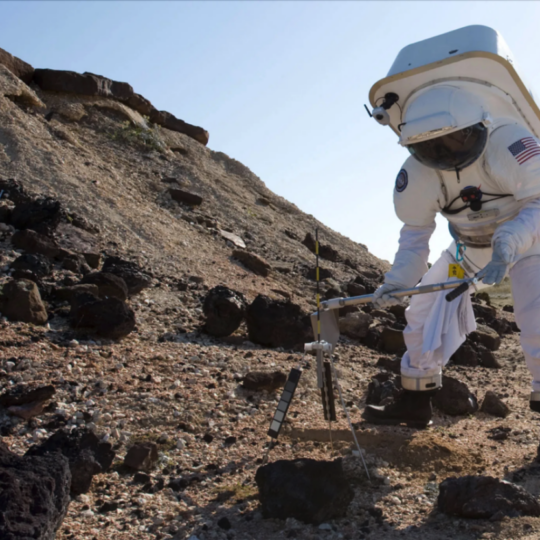
This unit is anchored by examining future plans to live and work for longer periods of time on the Moon (NASA Artemis mission). Students develop questions about how to find, recycle, and make the substances needed for living off Earth and on it. Students investigate planetary surface features (Earth’s and Mars’) to investigate water and its unique structure and function in erosion. They also develop understandings around physical science concepts of light and matter along with Earth and space science concepts of spectroscopy as a way to identify substances off of Earth. They then develop science ideas about the structure of atoms, the patterns in their bonds, the organization of the periodic table, electronegativity, bond character, and how these affect the polarity and properties of the molecule. Next, students develop and apply the idea of conservation of matter through chemical equations in the context of a variety of substances, including those that form ionic compounds and form polyatomic ions. Finally, students consider applications of ideas students figured out to issues related to recycling and sustainability, both off Earth and on it.
*This performance expectation is developed across multiple units.
†This performance expectation is developed across multiple courses.
Performance Expectations:
HS-PS1-1*, HS-PS1-2, HS-PS1-3*, HS-PS1-10* (NYSSLS), HS-PS2-6*, HS-PS4-4 (NYSSLS), HS-ESS1-2†, HS-ESS2-1†, HS-ESS2-5, *, †
Lesson Set 1: how can we find water and other substances we need to survive on other objects in space?
Lesson 1
What substances would we need and how would we get them to live and work beyond Earth?
Lesson 2
How does water support life and chemical reactions?
Lesson 3
How can we find evidence of the water we need on the surfaces of other objects in space?
Lesson 4
How and why do water and other liquids interact with materials to make surface features?
Lesson 5
How can we tell what is in the atmosphere (and just below the surface) of objects in space?
Lesson Set 2: why do we need certain types of atoms to create the substances we need?
Lesson 6
What patterns are there between the types of atoms and the number of bonds they form in the resources we need?
Lesson 7
Why is there a difference between the number of electrons an element has and the number of bonds an element forms?
Lesson 8
Could another substance serve as a substitute for water for some of the processes we need to use it for in space?
Lesson 9
How can the ideas we developed be applied to making a possible substitute for another substance?
Lesson Set 3: how can we make the substances we need to survive off of Earth using the existing matter in the solar system?
Lesson 10
Why do we need water in so many reactions?
Lesson 11
How can we grow food in space?
Lesson 12
Which location(s) in the solar system has the elements we need and what relative amount is required to make any substance?
Lesson Set 4: how can we be more sustainable in what we use and produce?
Lesson 13
Why can we recycle some of the substances we need and not others?
Lesson 15
What is the full impact of going to space?