Unit Overview
How can we slow the flow of energy on Earth to protect vulnerable coastal communities?
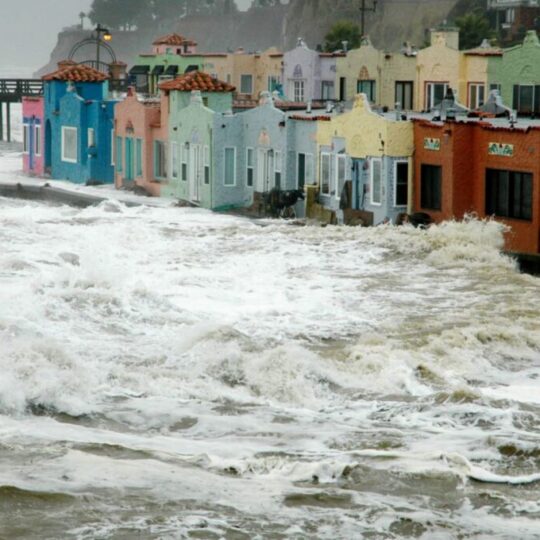
In this unit, students investigate how rising sea levels impact coastal communities. They analyze data linking sea level rise to polar ice melt and human-driven carbon dioxide emissions, explore a potential solution to slow the rise, and learn how energy transfers at both molecular and Earth-systems levels through radiation, convection, and conduction.
*This performance expectation is developed across multiple units.
†This performance expectation is developed across multiple courses.
Performance Expectations:
HS-PS3-1†, HS-PS3-4, HS-ESS2-4†, HS-ESS3-1*, *, †
Lesson Set 1: how and why is the sea level rising?
Lesson 1
How can we slow the flow of energy on Earth to protect vulnerable coastal communities?
Lesson 2
What can the past help us figure out about what is causing sea level rise in the present?
Lesson Set 2: what solutions could help slow polar ice melt?
Lesson 5
How can we best slow or stop the land ice melt?
Lesson Set 3: how well would the berm solution work in the context of Earth systems?
Lesson 8
What is going on where the ice meets the water?
Lesson 9
Why does warm salty water sink to melt a glacier?
Lesson 10
How can we measure the energy transfer a berm prevents?
Lesson 11
How does heat affect the amount of ice melt?
Lesson 12
How can we slow the flow of energy on Earth to protect vulnerable coastal communities?