NGSS Design Badge
Awarded: February 9, 2022
Awarded to: New Visions for Public Schools: Discovering New Worlds
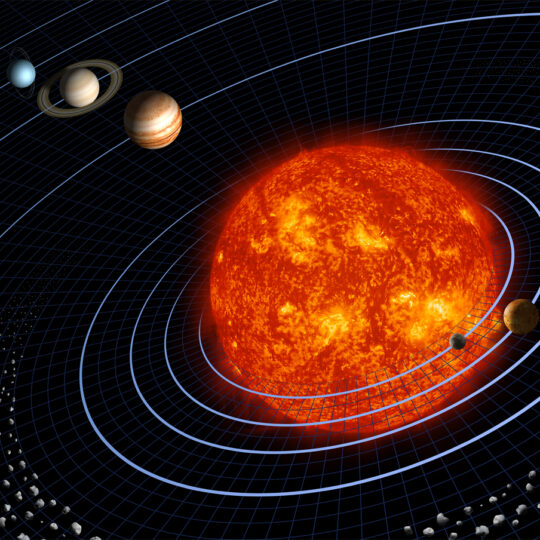
For almost 12,000 years, Earth has been an ideal place for humans and other living things to evolve. But a once very livable Earth is becoming less livable due to human-caused stresses to Earth’s systems. After brainstorming possible solutions, students investigate the possibility of finding another Earth-like home in our galaxy. Students develop a model to explain what makes Earth an ideal place for us to live based on patterns observed at different scales in data from simulations related to the stability of stars, planet formation, and planetary motion. They then use their models and explanations to consider other solar systems and to argue from evidence about which exoplanet is most Earth-like.
Performance Expectations:
HS-ESS1-1, HS-ESS1-3, HS-ESS1-4

Awarded: February 9, 2022
Awarded to: New Visions for Public Schools: Discovering New Worlds
What can humans do to survive as a species given the negative changes to planet Earth? What are your initial ideas about what has made Earth successful in having sustained life for so long?
Why is the Sun so important to life on Earth? How does the Sun work? How has the sun provided us with the “right” amount of energy for life to exist?
Does the exoplanet have a star like our Sun? What is our Sun like, compared to other stars? Do all stars become supernovas?
Is the exoplanet like Earth in terms of its distance from its star? What are the factors that allow an exoplanet to maintain a stable temperature?
Which exoplanet is most Earth-like?
Use our bulk downloader tool to copy the entire unit to your Google Drive.
In addition to the unit Performance Task, this unit includes a mid-unit formative task designed to serve as individual assessments that are part of a broader assessment system. View these assessments or learn more about our assessment system using the buttons below.