Blog

How One New Visions Scholarship Alum Built Her Community at an Ivy League School, Then Built Her Own Path to Entrepreneurship
Years before she was running her own consultancy, Mariam Tigane was a student at the Young Women’s Leadership School of Brooklyn, one of the schools in the New Visions affinity network, navigating the leap toward college with the support of a New Visions Scholarship. That leap took her to the University of Pennsylvania, where she went on to found Penn’s first minority-owned investment fund and bring a chapter of BlackGen Capital, one of the strongest national communities for underrepresented students entering financial services, to campus. From there, her path led through finance and into entrepreneurship. We sat down with her to talk about what made the difference, what she’d tell her younger self, and why she thinks the current moment calls for a different kind of career strategy.
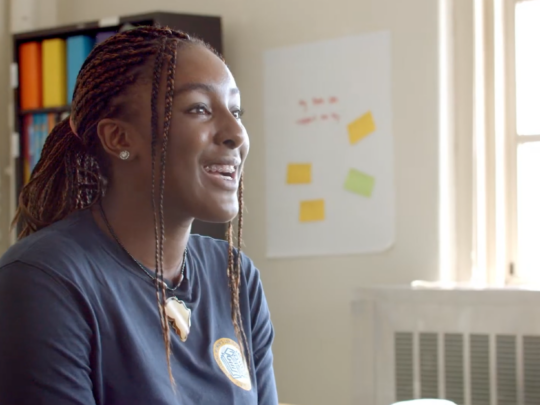


What do you remember about finding out you’d received the scholarship — and what did it make possible for you?
I remember feeling genuinely supported, not just financially, but like I was being welcomed into something. Even though we were in the middle of the pandemic and everything was virtual, New Visions made sure we got to connect with each other, share what we’d accomplished, hear about the mission. It felt like a cohort, not just a check.
What it actually made possible, though, that’s the part I didn’t expect. I’m a first-gen student, and when I got to Penn, I was looking for spaces to ground myself in. I wanted friends but I also wanted to develop a strong professional background. I ended up joining one of Penn’s oldest business fraternities, and the scholarship helped me pay the membership dues. It helped me buy suits and the right shoes for recruiting events. It helped me show up on par with students who had the level of financial support I didn’t. A regular scholarship might cover tuition but there are so many other costs that determine whether you can actually participate in the full experience of an Ivy League education. The level of exposure I was able to access due to having that financial support opened a ton of doors for me.
Looking back at your time at the Young Women’s Leadership School of Brooklyn, is there one person or experience you’d point to as foundational?
Absolutely. My teacher, Ms. Kapoor, Aricka Kapoor. She was there from the time I started in sixth grade all the way through graduation. She taught AP Psychology, and one day after lunch she sat me down and said, “I think you should apply to an Ivy League institution. You should put that on your own plate.” By my junior year, I had founded two separate organizations at my high school, took college classes after school was out, participated in public speaking opportunities at City Hall, etc. She was watching everything I was doing and seeing something I wasn’t seeing in myself. I didn’t think an Ivy League was in scope for me. She changed that.
Was there a moment in college when you felt completely out of your depth?
Yes, and ironically, it came from something I built myself. I served for one year on the business fraternity’s leadership team, then left mid-year the next because I realized I wasn’t making the kind of impact I wanted to. It was the first time I’d walked away from something I committed to. It felt like failure. And I didn’t even know what I was going to do next. At Penn, it felt like your extracurriculars are almost as important as your classes, especially if you’re headed into finance. So I took what I’d experienced — being literally the only Black women in the fraternity, in those rooms, realizing how many people from my background simply weren’t present — and I founded Penn’s first minority-owned investment fund through BlackGen Capital, which had started at Cornell, and I brought a chapter to Penn.
BlackGen provides a 10-week educational series that gives students of color the technical foundation, the professional knowledge, the interview prep — everything I had to essentially pay for through my scholarship. I think I was out of my depth in terms of feeling as though I wanted everything to work out perfectly. But of course, like starting anything, it was a rewarding experience, but it was hard. We didn’t win our first competition, or get some funding we were going after, or get as many recruits as we were hoping for in our first semester, etc. But it’s still running today, with 12 chapters nationally.
What did founding that chapter give you that you couldn’t have gotten on your own, and how did it shape the move from finance into entrepreneurship?
Penn gave me exposure. BlackGen gave me community. When you come from an underrepresented background, you want to succeed, but you don’t want to succeed alone because you know there aren’t many people from where you come from in those rooms.
The direct line to entrepreneurship came when BlackGen asked me to join the national board as Chief Operating Officer. I was coordinating across 10 chapters, securing corporate sponsors, and organizing conferences in Midtown at prestigious private equity firms. I quickly realized that you really can build anything from scratch. You can get people in a room, you can make things happen, and you don’t have to wait until you’re older or more established. If you have the ambition and the exposure and the connections to make those things possible, then no matter how young you are, you can do anything.
Why finance first, and what made you leave?
Fifty percent of Penn graduates go into consulting or banking. When that’s the water you’re swimming in, it starts to feel like the obvious path, even if you think of yourself as an independent thinker. Finance also gave me real skills: attention to detail, high-quality output, working under pressure, knowing how to ask questions and keep learning while still maintaining your professionalism.
But my major was Philosophy, Politics, and Economics. It’s an interdisciplinary major, which is how my brain works. What scared me was becoming “Mariam the finance person.” I wanted to be known for being multifaceted. I worked at a startup for a bit and liked operations and strategy, solving problems and building something from zero to one. My consultancy now works at the intersection of strategy, operations, and finance, helping leadership teams plan for long-term execution. It’s everything I was doing at BlackGen, just applied to organizations across sectors.
What’s something about owning your own business (strategic operations and AI consulting firm MAYAKAVI) that nobody warns you about?
There’s no paid sick leave, no PTO, no expense account — a lot of the things my friends in high finance have. But the thing nobody really warns you about is that you can’t look for the same level of incentive and validation that comes with a conventional path. On a traditional career track, someone is always telling you whether you’re on track — a manager, a performance review, a promotion. When you’re building something yourself, you have to create your own metrics for success and progression. You’re the only one who can pat yourself on the back and tell yourself you’re on the right path. That’s harder than it sounds. Especially on the days when the external signals aren’t there yet.
What does the current moment look like from your vantage point, as someone making real decisions as a young business owner?
Honestly, I think this is the most interesting and most complicated time to be entering the workforce. The cost of living is high, layoffs feel unpredictable, and even a full-time job at a legacy company no longer feels as safe as it once did. But I also think young people are uniquely positioned right now. AI has put tools in our hands that genuinely level the playing field. I’m a solopreneur and I have the equivalent of a full team at my fingertips. But the tools are only part of it. What I actually do is help organizations build the internal infrastructure to operate well: the systems, the processes, the reporting, the cross-functional coordination that lets leadership focus on what actually matters. AI can automate repetitive tasks, but there still needs to be a human thinking creatively and interdisciplinarily to make sense of it all and drive real execution.
My take is that when everything feels risky — including traditional employment — that’s actually a signal to take a considered risk on yourself. The way things have operated in the past isn’t working the same way. Young people who figure out a new strategy now, before it gets normalized, will be ahead.
What do you wish someone had told you before you got to Penn?
That I am enough. I knew I deserved my spot. I worked hard to get there. But I didn’t feel like I belonged. I didn’t feel like I fit in. So I became a workaholic to prove I could. That’s the way I dealt with imposter syndrome. I overextended myself, joined every leadership team. I even choreographed productions when I could have just taken a dance class. Looking back, I could have done one thing fully and been more than enough. I could have thought more deeply about my classes instead of just trying to complete all my assignments. I could have enjoyed it more and had more fun. Four years goes by incredibly fast.
If you could say one thing to a current scholarship recipient who’s worried they don’t belong in the room, what would it be?
Find your community. It doesn’t have to be people who come from where you come from or are cut from the same cloth. Be open to meeting new people. But your community, your friends, will give you the energy to bear through the hard parts and guide you through the experience, especially if no one in your family has been in those spaces before. They’re how you get the exposure, the connections, and honestly the stamina to keep going when it becomes a lot.
What does being part of the New Visions alumni network mean to you now?
I got to emcee the reception for the scholarship cohort recently and pass the baton, hear what current recipients are hoping for and share what I went through. I graduated during the pandemic, so I never got that in-person moment. Being in that room was reflective for me. It feels like being part of an ongoing tradition.